
The UK electrical industry is approaching another important milestone, with BS 7671:2018+A4:2026 — the latest version of the IET Wiring Regulations — moving towards becoming the sole edition that installers should be working to.
The past three months have seen further guidance published on Amendment 4, clarification around Electrical Installation Condition Reports (EICRs), and updated supporting publications. There have also been changes to wider building regulations that electricians involved with new-build and refurbishment work should be aware of.
The biggest issue for October 2026 is simple: the transition period for the previous version of BS 7671 is coming to an end.
Amendment 4:2026 moves towards mandatory use
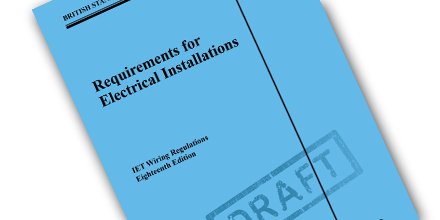
BS 7671:2018+A4:2026, often referred to as the “Orange Book”, is now available and represents a substantial update to the 18th Edition Wiring Regulations.
The IET says the previous BS 7671:2018+A3:2024 edition remains valid during a transition period until 15 October 2026. Until that date, installers can work to either version. After the transition period, the previous edition will no longer be the current standard.
For electricians and electrical contractors, October is therefore an important deadline.
Anyone still relying on the “Brown Book” should be making sure they have access to BS 7671:2018+A4:2026 and understand the changes before the transition period expires.
New requirements for battery storage
One of the most significant additions in Amendment 4 is a new chapter covering stationary secondary batteries.
This reflects the rapid growth in domestic and commercial battery energy storage systems.
Battery storage is increasingly being installed alongside solar PV, electric vehicle charging equipment and other low-carbon technologies. The IET says the new requirements are intended to address electrical energy storage and the supply of electrical installations.
This is particularly important for installers because battery systems can introduce different considerations from conventional electrical installations, including protection, isolation, earthing, installation location and interaction with other sources of supply.
The changes demonstrate how BS 7671 is increasingly having to accommodate installations where electricity is not simply supplied from the grid.
Power over Ethernet gets its own section
Another notable addition is a new section covering Power over Ethernet, or PoE.
PoE allows electrical power and data to be delivered through network cabling and is becoming increasingly common in buildings.
Examples include:
* Wireless access points
* CCTV cameras
* VoIP telephones
* Network equipment
* Building automation equipment
* IoT devices
The inclusion of PoE within BS 7671 recognises the growing overlap between traditional electrical installations and communications infrastructure.
This is an area that is likely to become increasingly important as smart buildings and connected devices become more widespread.
Functional earthing and ICT equipment
Amendment 4 also introduces requirements concerning functional earthing and functional equipotential bonding for information and communications technology equipment and systems.
This is another example of BS 7671 evolving beyond conventional mains electrical wiring.
Modern buildings contain increasing amounts of electronic equipment, networking infrastructure and communications systems. Earthing and bonding arrangements can therefore have implications not only for electrical safety but also for the reliable operation of sensitive electronic equipment.
Major changes to medical locations
Section 710, covering medical locations, has undergone a major revision.
The update also introduces a schedule of test results for recording the resistance of supplementary protective equipotential bonding conductors.
Medical electrical installations have particularly demanding requirements because loss of electrical supply or inadequate protection can have serious consequences.
Installers and inspectors working in hospitals, medical centres, dental practices and other healthcare environments should therefore pay particular attention to the revised requirements.
Changes to EICR reporting
One of the more immediately relevant changes for inspectors is the treatment of the FI — “Further Investigation” — classification on EICRs.
Under Amendment 4, C3 and FI classifications have been separated from C1 and C2 classifications.
Importantly, an FI classification no longer automatically makes an EICR unsatisfactory. The wording has also changed from further investigation being required “without delay” to further investigation being “advised”.
The IET has stressed that periodic inspection and testing is intended to establish whether an installation is suitable for continued use. It is not intended to become a general fault-finding exercise.
This distinction could make a significant difference to the way EICRs are interpreted by property owners, landlords and contractors.
“Isolator” is no longer the preferred terminology
Another relatively small but interesting change concerns terminology.
The word “isolator” has been removed from BS 7671 and is now considered too broad a term for the purposes of the Regulations.
Instead, the standard distinguishes between devices such as disconnectors and switch-disconnectors, depending on their characteristics and intended use.
The IET acknowledges that electricians will probably continue using the word “isolator” on building sites and in everyday conversation.
However, designers and those producing formal documentation should be aware of the terminology used in the latest edition.
Changes affecting switching and isolation
Amendment 4 also updates Table 537.4, which deals with protective, isolation and switching devices.
The revised table includes additional references to devices such as:
* Firefighters’ switches
* Residual direct-current protective devices
* Switched socket-outlets
* Switch-disconnectors
The changes are intended to give designers a clearer choice of equipment while making the different functions of devices easier to understand.
This is particularly relevant to installations incorporating EV charging and other modern electrical equipment.
EV charging and battery systems remain major areas
Although electric vehicle charging is not itself a completely new subject within BS 7671, Amendment 4 needs to be viewed against the rapid growth of EVs, battery storage and renewable generation.
Electrical Safety First says Amendment 4 reflects the changing way electricity is generated, stored and used in homes, where EV charging, battery storage, solar PV and ICT infrastructure are increasingly common.
This means electricians increasingly need to consider an installation as an integrated energy system rather than simply a collection of socket outlets and lighting circuits.
Supporting guidance has also been updated
The changes aren’t limited to the main Wiring Regulations book.
The IET has been updating its supporting publications to bring them into line with Amendment 4. This includes the new ninth edition of the On-Site Guide and updated editions of Guidance Notes covering areas such as:
* Selection and erection
* Isolation and switching
* Inspection and testing
* Protection against fire
* Protection against electric shock
* Protection against overcurrent
* Special locations
* Earthing and bonding
The IET says these publications have been updated to BS 7671:2018+A4:2026.
For electricians using older copies of the guidance, this is an important consideration because simply owning the latest Wiring Regulations book may not provide all of the updated practical guidance needed for day-to-day work.
Changes to wider building regulations
There have also been some recent developments outside BS 7671 that could affect electrical work.
In England, the Government updated Approved Document L during September 2026, including revisions to the guidance covering energy efficiency and greenhouse gas emissions. The September update included corrections to the 2026 editions and new frequently asked questions. ([GOV.UK][7])
The Government has also issued a September 2026 direction concerning fibre-optic cabling in existing non-higher-risk buildings.
From 1 September 2026, certain work involving drilling holes no larger than 25mm through walls for fibre-optic cabling is covered by a specific dispensation from certain Building Regulations procedural requirements.
While this isn’t a change to BS 7671 itself, it is relevant to contractors working on modern communications infrastructure alongside electrical installations.
What electricians should do now
With the 15 October transition deadline approaching, electrical contractors should consider the following:
1. Make sure you have access to BS 7671:2018+A4:2026.
2. Familiarise yourself with the changes rather than simply replacing the old book.
3. Update your inspection and testing procedures.
4. Check EICR documentation and understand the revised FI classification.
5. Review procedures for battery storage and other energy-storage installations.
6. Pay particular attention to EV charging and multiple sources of supply.
7. Update company templates, certificates and documentation where necessary.
8. Make sure staff and apprentices are working from current guidance.
9. Check that supporting publications such as the On-Site Guide and Guidance Note 3 have been updated.
10. Remember that BS 7671 is a standard rather than an Act of Parliament — other statutory requirements, including Building Regulations, still need to be considered.
The big change for October 2026
For most electricians, the most important development over the coming weeks is the end of the BS 7671 transition period.
The IET currently states that BS 7671:2018+A3:2024 remains valid until 15 October 2026. After that date, Amendment 4 becomes the version installers need to be working from. ([IET Wiring Regulations][1])
The changes are much broader than a simple collection of minor amendments. Battery storage, PoE, ICT systems, medical locations, EICR reporting, switching and isolation are all examples of how electrical installations are changing.
With homes increasingly incorporating solar panels, battery storage, EV chargers, heat pumps, smart devices and high-speed communications, BS 7671 is evolving to cover a much more interconnected electrical environment.
For electricians, the message is clear: **the move to Amendment 4 is now very close, and October 2026 marks an important point in the transition to the latest UK Wiring Regulations.**
*This article is intended as a general news and information overview. Electrical work should always be designed, installed, inspected and tested by appropriately competent persons using the current BS 7671 requirements, applicable legislation and manufacturer instructions.*